
Market Overview:
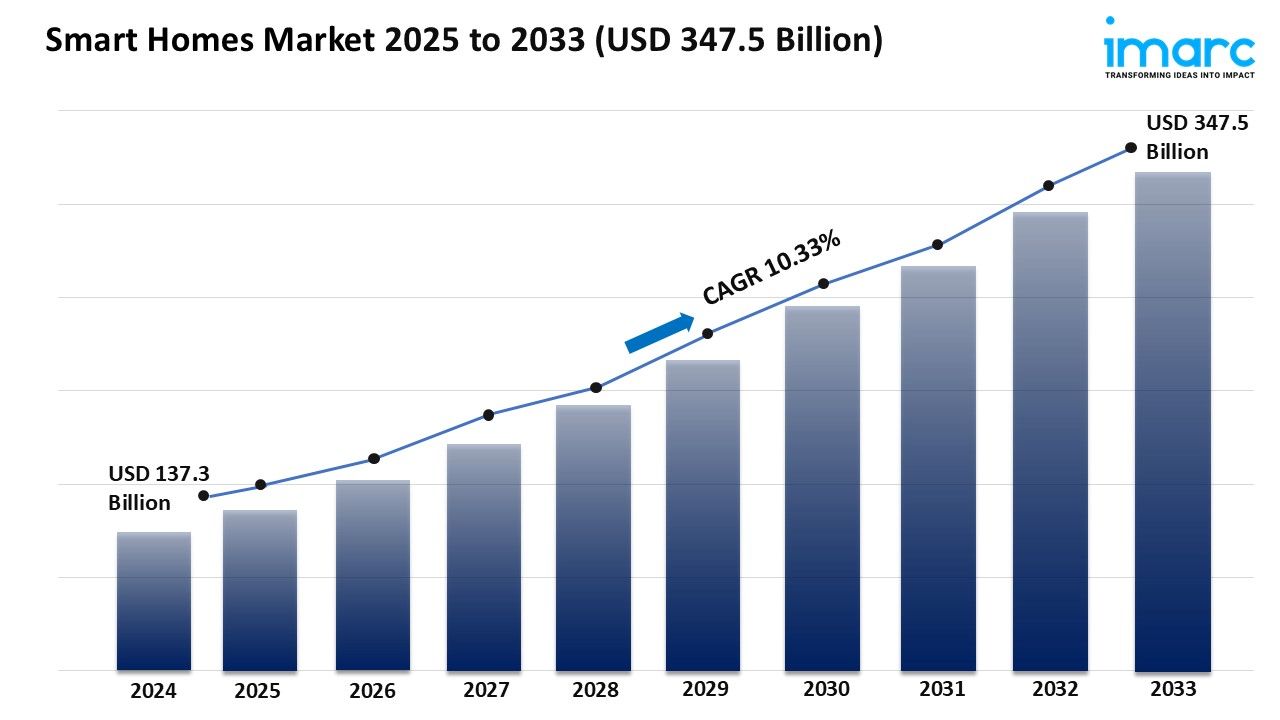
The smart homes market is experiencing rapid growth, driven by expanding connectivity and the power of IoT, government backing and housing incentives, and surge in security, energy savings, and sustainability. According to IMARC Group's latest research publication, "Smart Homes Market Size, Share, Trends and Forecast by Component, Application, and Region, 2025-2033", the global smart homes market size was valued at USD 137.3 Billion in 2024. Looking forward, IMARC Group estimates the market to reach USD 347.5 Billion by 2033, exhibiting a CAGR of 10.33% from 2025-2033.
This detailed analysis primarily encompasses industry size, business trends, market share, key growth factors, and regional forecasts. The report offers a comprehensive overview and integrates research findings, market assessments, and data from different sources. It also includes pivotal market dynamics like drivers and challenges, while also highlighting growth opportunities, financial insights, technological improvements, emerging trends, and innovations. Besides this, the report provides regional market evaluation, along with a competitive landscape analysis.
Download a sample PDF of this report: https://www.imarcgroup.com/smart-homes-market/requestsample
Our report includes:
- Market Dynamics
- Market Trends and Market Outlook
- Competitive Analysis
- Industry Segmentation
- Strategic Recommendations
Growth Factors in the Smart Homes Market
- Expanding Connectivity and the Power of IoT
A huge driver for the smart homes industry right now is the explosive spread of connected devices and high-speed internet. With more than 2.25 billion 5G subscriptions worldwide and 182 million 5G connections in North America alone, homeowners can install and control smart devices with just a tap on their smartphones. The rapid penetration of broadband and mobile networks—a foundation for smart living—makes it easy to manage security cameras, lighting, climate, and entertainment remotely. As IoT-enabled gadgets become standard, people are realizing the benefits of syncing multiple devices for seamless automation. Smart cameras, voice assistants, and appliances are all communicating on the same network, delivering instant updates and performance monitoring. This always-on connectivity offers both convenience and peace of mind, which continues to accelerate adoption among tech-savvy buyers and families keen on practical, secure homes.
- Government Backing and Housing Incentives
Supportive government schemes worldwide are making smart home technology accessible, especially to first-time buyers and various income groups. In India, for example, the Pradhan Mantri Awas Yojana – Urban 2.0 (PMAY-U 2.0) continues to avail interest subsidies to low and middle-income purchasers, helping thousands access affordable, tech-ready homes. Central and local programs like the Smart Cities Mission have pumped over ₹46,787 crore into digitizing city infrastructure, including installations of smart surveillance, efficient utilities, and automated waste management. Globally, similar incentives—such as tax credits on energy-saving appliances in the US and housing partnerships in Asia—support installation of eco-friendly devices and retrofit upgrades. State-specific programs further provide subsidies and housing allotments, narrowing the smart home gap for millions who previously saw digital convenience as out of reach. This policy push ensures sustainable, tech-integrated living isn’t just for premium buyers—it's increasingly mainstream.
- Surge in Security, Energy Savings, and Sustainability
Modern consumers are prioritizing both safety and sustainability, boosting demand for smart security systems and energy-efficient appliances. For instance, advanced smart home solutions like motion-sensor lighting can reduce energy usage by 35-45%. Homeowners are actively investing in AI-driven cameras, smart locks, and remote monitoring to keep their properties secure, whether they're at home or miles away. Global programs to cut carbon footprints are pushing millions to adopt smart thermostats, intelligent lighting, and power-saving gadgets that optimize usage based on real-time occupancy or schedule. With the ability to monitor and control electricity consumption, many are delighting in lower utility bills and a reduced environmental impact, while governments amplify these benefits with incentives and certifications. Increasingly, brands are responding with new lines of energy-saving, AI-powered appliances—like Samsung’s latest Bespoke AI products—cementing the importance of security and sustainability in the smart living journey.
Key Trends in the Smart Homes Market
- AI-Powered Personalization and Automation
Artificial intelligence isn’t just a buzzword—it’s reshaping the smart home experience by learning individual preferences and habits to deliver personalized comfort. Leading platforms like Amazon Alexa, Google Assistant, and Apple HomeKit aren’t just voice-activated, they’re using machine learning to predict user needs. For example, systems now automatically adjust lighting, climate settings, or security protocols based on the time of day, occupancy, or even your historical patterns. This predictive automation means your home can, for instance, cool itself before you arrive or dim smart lights as you wind down at night—no manual input required. With natural language processing dramatically improving, chatting with a virtual assistant feels effortlessly conversational. Users are already seeing real-time benefits, from proactive appliance maintenance alerts to tailored entertainment suggestions, all driven by advanced AI embedded in everyday home devices.
- Seamless Integration and Interoperability
Another hot trend is the industry-wide push toward seamless integration. Consumers want smart home devices that just work together, regardless of brand. With the rollout of open standards like Matter, device makers are finally delivering genuine cross-brand compatibility. That means your smart lock, thermostat, lights, and security cameras can all talk to each other, enabling centralized control—whether via smartphone app or voice command. Companies like Samsung are leading with new appliance lines that link up effortlessly with smart home platforms like SmartThings, bringing a truly connected lifestyle. Real-world results: a resident can unlock the front door and have the hallway lights turn on, climate adjust, and favorite music play—all in perfect sync. This interoperability lowers the headache of managing different ecosystems and is driving faster adoption, making advanced smart living accessible to more people than ever before.
- Focus on Energy Efficiency and Sustainability
Sustainability is now a core expectation, not a luxury, in the smart homes market. Consumers are gravitating toward solutions that help reduce utility costs and environmental impact—in some cases, motion-sensor switches and smart appliances are delivering up to 45% energy savings. Integration of smart meters, rooftop solar, and home battery solutions allow users to monitor and optimize their consumption and even feed energy back to the grid. Many countries now offer incentives for retrofitting homes with energy-saving gadgets, accelerating adoption for both residential and multi-family buildings. Residents in tech-equipped apartments are even willing to pay monthly rent premiums of 5–25%, just for the convenience and promise of greener living. Ultimately, these innovations are allowing homeowners to align their day-to-day routines with broader climate goals, resulting in both immediate savings and a healthier planet.
We explore the factors propelling the smart homes market growth, including technological advancements, consumer behaviors, and regulatory changes.
Leading Companies Operating in the Global Smart Homes Industry:
- ABB Ltd
- Amazon.com Inc.
- Emerson Electric Co.
- Honeywell International Inc.
- LG Electronics Inc.
- Lutron Electronics Co. Inc.
- Microsoft Corporation
- Robert Bosch GmbH
- Schneider Electric SE
Smart Homes Market Report Segmentation:
By Component:
- Hardware
- Security
- Home Automation
- Home Entertainment
- Home Healthcare
- Smart Appliances
- AI Speaker
- Services
- Energy Consumption and Management Services
- Security Services
- Healthcare Services
- Entertainment Services
Hardware represents the largest segment as it is essential for automation and control.
By Application:
- Security and Surveillance
- Lighting
- Entertainment
- Energy Management
- HVAC
- Smart Kitchen
- Home Fitness and Wellness
Security and surveillance hold the biggest market share on account of the increasing focus on enhancing home security.
Regional Insights:
- North America: (United States, Canada)
- Asia Pacific: (China, Japan, India, South Korea, Australia, Indonesia, Others)
- Europe: (Germany, France, United Kingdom, Italy, Spain, Russia, Others)
- Latin America: (Brazil, Mexico, Others)
- Middle East and Africa
North America enjoys a leading position in the smart homes market due to the escalating demand for modern living solutions among individuals.
Note: If you require specific details, data, or insights that are not currently included in the scope of this report, we are happy to accommodate your request. As part of our customization service, we will gather and provide the additional information you need, tailored to your specific requirements. Please let us know your exact needs, and we will ensure the report is updated accordingly to meet your expectations.
About Us:
IMARC Group is a global management consulting firm that helps the world’s most ambitious changemakers to create a lasting impact. The company provide a comprehensive suite of market entry and expansion services. IMARC offerings include thorough market assessment, feasibility studies, company incorporation assistance, factory setup support, regulatory approvals and licensing navigation, branding, marketing and sales strategies, competitive landscape and benchmarking analyses, pricing and cost research, and procurement research.
Contact Us:
IMARC Group
134 N 4th St. Brooklyn, NY 11249, USA
Email: [email protected]
Tel No:(D) +91 120 433 0800
United States: +1-201971-6302